Tuesday, 2 October 2012

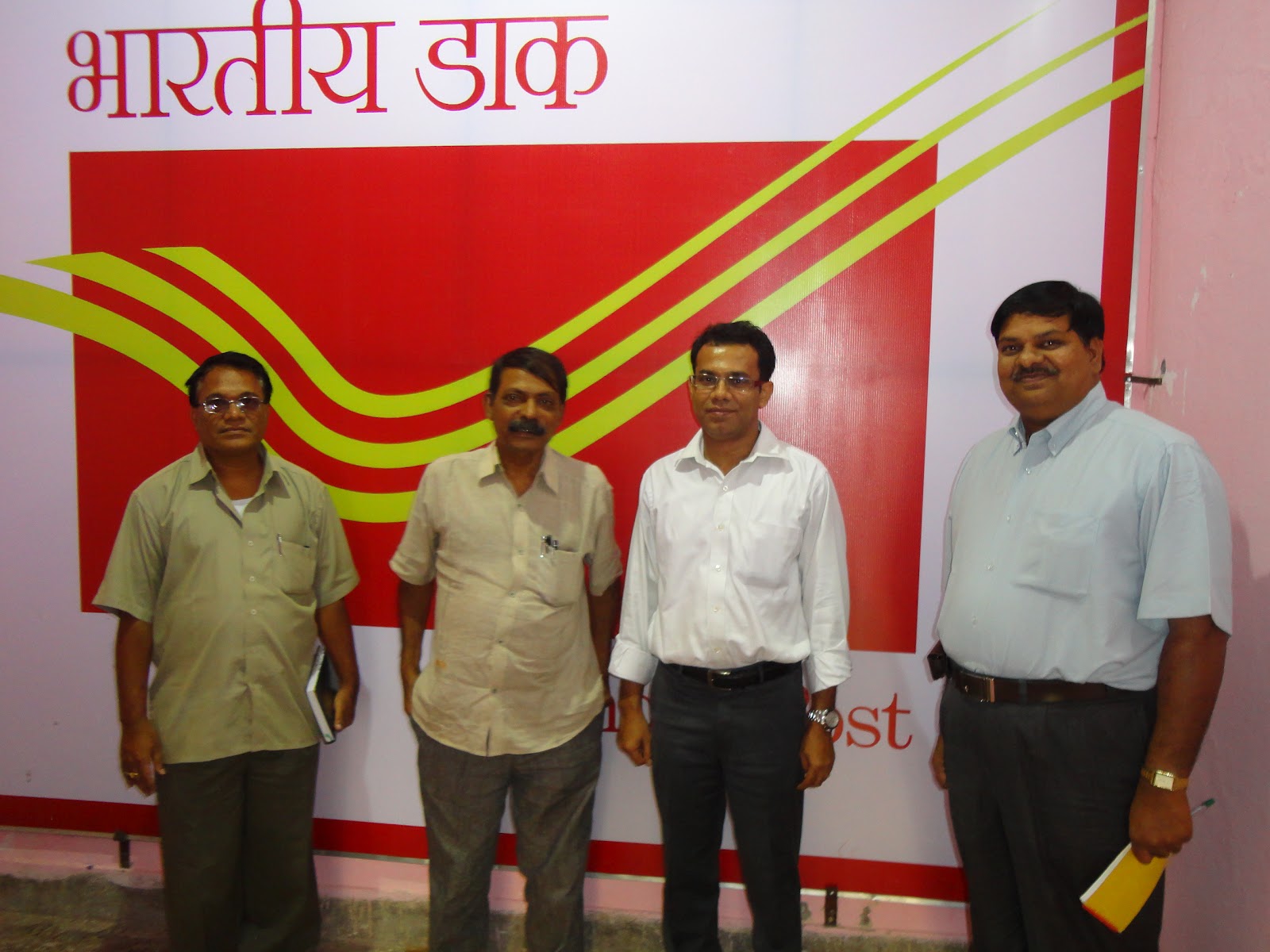
BPM TRAINING HELD AT B-Camp LSG SO on 02-10-2012

Training for Branch Post Masters of Kurnool East Sub Division and Yemmiganur Sub Division has been held   in B-Camp LSG SO on 02-10-12.  Sri.JNMVR Prasad, Inspector Posts, East Sub Division conducted this training.  Aspects relating to regular work of the BPMs, RPLI and NREGS issues discussed in the training session and an examination was also conducted by the Inspector at the end of the session.  Related photos are kept here under for perusal.


Monday, 1 October 2012

SP GOURP MEMBER BRANCH POST MASTERS OF DHONE SUB DIVISION

Dynamic BPMs were selected fromDhone Sub Diviion each from one Sub Post Office.  These BPMs will be members of SP Club and will get privileges as admissible.  Meeting held with these STAR BPMs on22.09.2012 and related photographs are kept here under for perusal.


Saturday, 29 September 2012

TIPS FOR GOOD HEALTH


PLI BONUS RATES FOR THE YEAR 2009-10

Simple Reversionary Bonus rate for the year ending 31.03.2010 on the Postal Life Insurance Policies on their becoming claim, due to death or maturity:-


Sl. No.

Type of Insurance Policy

Rate of Bonus

1

Whole Life Assurance (WLA)

Rs.85/- per thousand sum assured


2

Endowment Assurance (EA)

Rs.60/- per thousand sum assured

3

Money Back Policies (AEA)

Rs.55/- per thousand sum assured


4

Convertible Whole Life Policies

Whole Life Bonus would be applicable but on conversion, Endowment Bonus rate will be applicable

5

Terminal Bonus

Rs.20/- per sum assured of Rs.10,000/- subject to maximum of Rs.1,000/- for whole life policies and Endowment policies with term of 20 years and above.


Thursday, 20 September 2012

SP GOURP MEMBER BRANCH POST MASTERS OF YEMMIGANUR SUB DIVISION


Dynamic BPMs were selected from Yemmignaur Sub Diviion each from one Sub Post Office.  These BPMs will be members of SP Club and will get privileges as admissible.  Meeting held with this STAR BPMs on 07.09.2012 and related photographs are kept here under for perusal.


Monday, 17 September 2012

DIRECTOR MAILS, DIRECTORATE, NEW DELHI, WITH POSTMSTER GENERAL, KURNOOL REGION AT KURNOOL DIVISIONAL OFFICE


BSNL Offers 20% Discount to Central Government employees and Pensioners


BSNL offers 20% special discount to Central and State Government employees and Pensioners on usage and rental charges on Wireless Broadband (WiMAX) Postpaid connections.
 
In order to increasing of broadband services with grace to all serving and retired Central Govt., State Govt. and PSU employees, visually impaired, BSNL staff, BSNL has announced a special discount scheme of 20% discount on usage and rental postpaid wireless broadband services.
BSNL already provided the scheme of 20% discount on usage and rental for WiMAX postpaid connections provided under WI 750 (Limited 4GB upto 2 Mbps) and HOWI 750 (Unlimited-512 Kbps) plans with effect from April 2012, in addition to the same, now BSNL has decided to offer the same 20% discount on usage of rental of WiMAX postpaid connections under plans WI 220, WI 350, HOWI 999, as a promotional measure for 90 days with effect from 1.10.2012.
 
The above said discount schemes should not be clubbed with any other special discount or concession schemes and the discount scheme is not applicable to prepaid plans.
 
The eligible subscribers of BSNL, serving employees must obtain approval from their Head of Department in the prescribed application form.

Sunday, 2 September 2012

PA / SA Direct Recuitment Applications available in ONLINE


Good news for applicants of PA / SA Recruitment 2011 & 2012. Now you can get applications  PA / SA Recruitment  Online.

Postal Directorate has requested the outsourced agency to print 10 lacs OMR kits for sale throughout India thro selected POs. Due to huge sale of forms, it is difficult to print within short period. Hence Dte is decided to upload the forms in www.indiapost.gov.in so as to download by the applicants.


Online application kits will be available in www.indiapost.gov.in 

from
                   03.09.12 to 25.09.12         only.


Those applied thro OMR kits need not apply again.


Online Procedure :

Click “Register Online” link.

Enter the details like a. Name b.DoB c.e mail ID d. Alternative e mail ID.

Click Submit button.

The following forms will be sent to the provided e mail ID within 24 hrs.

a. Special instruction sheet.
b. Application form.
c. Instruction sheet / Information brochure (11 sheets).

Fees :

Cost of Application form - Rs.50
Exam fee – Rs.200. Female, SC, ST & PH applicants are exempted, however they should pay Rs.50.

Total Rs.250 should be paid under Unclassified Receipts thro any POs and attach Original alongwith the Application form.

Applicants can keep Xerox copies.

Applications should forward thro either Speed Post of Regd Post (other meant not accepted) to the following address.

Direct Recruitment Cell,
New Delhi HO,
New Delhi 110 001

Applicants can check the status of receipt of Cell on www.indiapost.gov.in

For more details, pl refer the advertisement of the concerned Circles.

Dte Memo No : A-34012 / 5 /2011-DE Dt. 31.08.12.

Thursday, 30 August 2012

FREQUENTLY ASKED QUESTIONS (FAQs) ON RTI (AS ON JANURARY 2012)


Q.1. What is Information?
Information is any material in any form. It includes records, documents, memos, e-mails, opinions, advices, press releases, circulars, orders, logbooks, contracts, reports, papers, samples, models, data material held in any electronic form. It also includes information relating to any private body which can be accessed by the public authority under any law for the time being in force.

Q.2 What is a Public Authority?
A “public authority” is any authority or body or institution of self government established or constituted by or under the Constitution; or by any other law made by the Parliament or a State Legislature; or by notification issued or order made by the Central Government or a State Government. The bodies owned, controlled or substantially financed by the Central Government or a State Government and non-Government organisations substantially financed by the Central Government or a State Government also fall within the definition of public authority. The financing of the body or the NGO by the Government may be direct or indirect.

Q.3 What is a Public Information Officer?
Public authorities have designated some of its officers as Public Information Officer. They are responsible to give information to a person who seeks information under the RTI Act.

Q.4 What is an Assistant Public Information Officer?
These are the officers at sub-divisional level to whom a person can give his RTI application or appeal. These officers send the application or appeal to the Public Information Officer of the public authority or the concerned appellate authority. An Assistant Public Information Officer is not responsible to supply the information. The Assistant Public Information Officers appointed by the Department of Posts in various post offices are working as Assistant Public 2 Information Officers for all the public authorities under the Government of India.

Q.5. What is the Fee for Seeking Information from Central Government Public Authorities?
A person who desires to seek some information from a Central Government Public Authority is required to send, along with the application, a demand draft or a banker’s cheque or an Indian Postal Order of Rs.10/- (Rupees ten), payable to the Accounts Officer of the public authority as fee prescribed for seeking information. The payment of fee can also be made by way of cash to the Accounts Officer of the public authority or to the Assistant Public Information Officer against proper receipt. However, the RTI Fee and the mode of payment may vary as under Section 27 and Section 28, of the RTI Act, 2005 the appropriate Government and the competent authority, respectively, by notification in the Official Gazette, make rules to carry out the provisions of this Act.

Q.6. What is the Fee for the BPL applicant for Seeking Information?
If the applicant belongs to below poverty line (BPL) category, he is not required to pay any fee. However, he should submit a proof in support of his claim to belong to the below poverty line.

Q.7. Is there any specific Format of Application?
There is no prescribed format of application for seeking information. The application can be made on plain paper. The application should, however, have the name and complete postal address of the applicant.

Q.8. Is it required to give any reason for seeking information?
The information seeker is not required to give reasons for seeking information.

Q.9. Is there any provision for exemption from Disclosure of Information?
Sub-section (1) of section 8 and section 9 of the Act enumerate the types of information which is exempt from disclosure. Sub-section (2) of section 8, however, provides that information exempted under sub-section 3 (1) or exempted under the Official Secrets Act, 1923 can be disclosed if public interest in disclosure overweighs the harm to the protected interest.

Q.10. Is there any assistance available to the Applicant for filing RTI application?
If a person is unable to make a request in writing, he may seek the help of the Public Information Officer to write his application and the Public Information Officer should render him reasonable assistance. Where a decision is taken to give access to a sensorily disabled person to any document, the Public Information Officer, shall provide such assistance to the person as may be appropriate for inspection.

Q.11. What is the Time Period for Supply of Information?
In normal course, information to an applicant shall be supplied within 30 days from the receipt of application by the public authority. If information sought concerns the life or liberty of a person, it shall be supplied within 48 hours. In case the application is sent through the Assistant Public Information Officer or it is sent to a wrong public authority, five days shall be added to the period of thirty days or 48 hours, as the case may be.

Q.12. Is there any provision of Appeal under the RTI Act?
If an applicant is not supplied information within the prescribed time of thirty days or 48 hours, as the case may be, or is not satisfied with the information furnished to him, he may prefer an appeal to the first appellate authority who is an officer senior in rank to the Public Information Officer. Such an appeal, should be filed within a period of thirty days from the date on which the limit of 30 days of supply of information is expired or from the date on which the information or decision of the Public Information Officer is received. The appellate authority of the public authority shall dispose of the appeal within a period of thirty days or in exceptional cases within 45 days of the receipt of the appeal.

Q.13. Is there any scope for second appeal under the RTI Act?
If the first appellate authority fails to pass an order on the appeal within the prescribed period or if the appellant is not satisfied with the order of the first appellate authority, he may prefer a second appeal with the Central Information Commission within ninety days from the date on which the decision should have been made by the first appellate authority or was actually received by the appellant.

Q.14. Whether Complaints can be made under this Act? If yes, under what conditions?
If any person is unable to submit a request to a Public Information Officer either by reason that such an officer has not been appointed by the concerned public authority; or the Assistant Public Information Officer has refused to accept his or her application or appeal for forwarding the same to the Public Information Officer or the appellate authority, as the case may be; or he has been refused access to any information requested by him under the RTI Act; or he has not been given a response to a request for information within the time limit specified in the Act; or he has been required to pay an amount of fee which he considers unreasonable; or he believes that he has been given incomplete, misleading or false information, he can make a complaint to the Information Commission.

Q.15. What is Third Party Information?
Third party in relation to the Act means a person other than the citizen who has made request for information. The definition of third party includes a public authority other than the public authority to whom the request has been made.

Q.16. What is the Method of Seeking Information?
A citizen who desires to obtain any information under the Act, should make an application to the Public Information Officer of the concerned public authority in writing in English or Hindi or in the official language of the area in which the application is made. The application should be precise and specific. He should make payment of application fee at the time of submitting the application as prescribed in the Fee Rules.

Q.17. Is there any organization(s) exempt from providing information under RTI Act?
Yes, certain intelligence and security organisations specified in the Second Schedule, are exempted from providing information excepting the information pertaining to the allegations of corruption and human rights violations.

Source : DOPT

Tuesday, 28 August 2012

FREQUENTLY ASKED QUESTIONS (FAQs) ON MODIFIED ASSURED CAREER PROGRESSION SCHEME


DOPT published some important instructions and standing orders through an order regarding MACP Scheme as FAQ.

FREQUENTLY ASKED QUESTIONS (FAQs) ON MODIFIED ASSURED CAREER PROGRESSION SCHEME

1. What is Modified Assured Career Progression Scheme (MACPS) ?
The MACP Scheme for Central Civilian Government Employees is in supersession of earlier ACP Scheme. Under the MACP Scheme three financial Up-gradations are allowed on completion of 10,20,30 years of regular service, counted from the direct entry grade. The MACPS envisages merely placement in the immediate next higher grade pay as given in Section I, Part-A of the first schedule of the CCS (Revised Pay) Rules 2008, in case no promotion has been earned by the employee during this period.
  
2. From which date the MACPS is effective?
The MACPS is effective w.e.f. 01.09.2008 or on completion of 10, 20 & 30 years of continuous regular service, whichever is later. Financial upgradation will also be admissible whenever a person has spent 10 years continuously in the same grade pay. (Para 9 of OM dated 19/5/2009)

3. Who are entitled for financial under the MACPS?
The MACPS is applicable to all Central Government Civilian Employees.
  
4. What norms are required to be fulfilled while granting the benefits under MACPS?
The financial upgradation would be on non-functional basis subject to fitness in the hierarchy of pay band and grade pay within PB- 1. Thereafter, only the benchmark of ‘Good’ would be applicable till the grade pay of Rs.6600 In PB-3. The benchmark will be ‘Very Good’ for Financial upgradation to the grade pay of Rs.7600 and above. However, where the Financial upgradation under the MACPS also happen to be in the promotional grade and benchmark for promotion is lower than the benchmark for granting the benefits under MACPS as mentioned in para 17 of the Scheme, the benchmark for promotion shall apply to MACP also.
O.M.N0.5034/3/2008-Estt(D) dated 01/11/2010
  
5. Whether Pay Band would be changed at the time of grant of financial upgradation under MACPS?
Yes.
OM.N0.35034/3/2008-Estt.(D) dated 09/09/2010
  
6. Whether the promotions in same grade would be counted for the purpose of MACPS?
The financial up-gradation under the MACPS is in the immediate next higher grade pay in the hierarchy of recommended revised pay bands and grade pay as given in CCS (Revised Pay) Rules, 2008. However if the promotional hierarchy as per recruitment rules is such that promotions are earned in the same grade pay, then the same shall be counted for the purpose of MACPS.
  
7. How will the benefits of ACP be granted if due between 01 .01.2006 and 31.08.2008?
The revised pay structure has been changed w.e.f. 01.01.2006 and the benefits of ACPS have been allowed till 31.08.2008. Hence, the benefits of revised pay structure would be allowed for the purpose of ACPS.
(OM No.35034/3/2008-Estt. dated 9.9.2010)

8. Whether adhoc appointment would be counted towards qualifying service for MACPS?
No. Only continuous regular service is counted towards qualifying service for the purpose of MACPS. The regular service shall commence from the date of joining of a post in direct entry grade on a regular basis. (Para 9 of the MACPS)
  
9. Whether State Government service shall be reckoned for the purpose of MACPS?
No. Only regular service rendered in the Central Government’s Department/Office is to be counted for the purpose of MACPS, as the Scheme is applicable to the Central Government Civilian Employees only. ( MACPS , Para 10)
  
10. What are the periods included in the regular service?
All period spent on deputation/foreign service, study leave and all other kind of leave, duly sanctioned by the competent authority shall be included in the regular service. (Para 11. MACPS)
  
11. How is the MACPS to be extended to the employees of Autonomous and Statutory Bodies?
Procedure prescribed in OM No.35034/3/2010- Estt(D),Dated 03/08/2010 would be followed by the administrative Ministries/Departments concerned for extension of the MACPS to the employees of Autonomous and Statutory Bodies under their control.
  
12. Whether the cases of grant of financial upgradation allowed under the ACPS between 01.09.2008 and 19.05.2009, the date of issue of the Scheme are be reviewed?
Yes. Since the benefits of ACPS have been discontinued w.e.f. 01.09.2008, the cases settled between 01.09.2008 and 19.05.2009, in terms of previous ACP Scheme shall be reviewed.
  
13. Whether the past continuous regular service in another Govt.Deptt. in a post carrying same grade pay prior to regular appointment in a new Deptt. without a break shall be counted towards qualifying regular service for the purpose of MACPS?
Yes. ( Para 9, MACPS)
  
14. Upto what grade pay the benefits under the / MACPS is allowed?
The benefits of MACPS are being up-to HAG scale of Rs. 67000 – 79000/- (DOPT’s O.M.No.35034/3/2008-Estt.(D) dated 24.12.2010)
  
15. How the cases of pre-revised pay scales (Rs.5000-8000 & Rs.5500-9000 and Rs.6500-10500 & Rs.7450-11500) merged w.e.f. 01.01.2006 are to be decided under MACPS?
The cases would be regulated in accordance with para 5 of Annexure-I of MACPS. The Ministries/Departments are expected to re-organise cadres and frame common RRs for the post in merged scales.
  
16. Whether ‘Non-functional Scale’ of Rs.8000-13500 (revised to grade pay of Rs.5400 in PB-3) would be viewed as one financial upgradation for the purpose of MACPS?
Yes, in terms of para 8.1 of Annexure-I 01 MACPS dated 19.05.2009.
  
17. Whether time bound promotion’ scheme including ‘in-situ promotion’ scheme can run concurrently with MACPS?
No. ( Para 13 of MACPS)
  
18. Whether Staff Car Drive Scheme can run concurrently with MACPS?
DOPT vide O.M.No.35011/03/2008-Estt.(D),30/07/2010 has extended the benefits of MACPS to Staff Car Drivers as a fall back option

19. Whether the placement of erstwhile Gr. D employees as Staff Car Driver, ordinary grade would count as a promotion?
No. The model RRs for Staff Car Drivers provide deputation/absorption as a method of appointment for erstwhile Gr. D employees . The placement as staff Car Driver is not in the hierarchy hence the same would not be counted as promotion under MACPS. The regular service for the MACPS would be from the date of appointment as Staff Car Driver.
  
20. Whether designation classification or higher status would change on account of financial upgradation under MACPS?
There shall be no change in the designation classification or higher status on grant of financial upgradation under MACPS, as the upgradation under the Scheme is purely personal and merely placement in the nexl higher grade pay. (Para 16 of Annexure-l of MACPS refers)

21. If a financial upgradation under the MACPS is deferred due to the reason of the employees being ‘unfit’ or due to departmental proceedings, etc, whether this would have consequential effect on the subsequent financial upgradation?
Yes, this would have consequential effect on the subsequent financial upgradation, which would also get deferred to the extent of delay in grant of financial upgradation. ( MACPS, Para 15)
  
22. Whether the stepping up of pay would be admissible if a junior is getting more pay than the senior on account of grant of financial upgradation under MACPS?
No stepping up of pay in the band or grade pay would be admissible with regard to junior getting more pay than the senior on account of pay fixation under MACPS.
Para 10 of OM dated 19/5/2009
  
23. Whether the regular service rendered by an employee if declared surplus in his/her organisation and appointed in the same grade pay or lower grade pay shall be counted towards the regular service in a new organization for the purpose of MACPS?
Yes. (refer para 23 of Annexure-l of MACPS)
  
24. In case of transfer including unilateral transfer own request, whether regular service rendered in previous organisation/office shall be counted alongwith the regular service in the new organization for the purpose of MACPS?
Yes. OM No.35034/3/2008-Estt(D) dated 01/11/2010

25. If a regular promotion has been offered but was refused by the employees before becoming entitled to a financial upgradation under the MACPS, whether financial upgradation shall be allowed to such a Government servant?
If a regular promotion has been offered but was refused by the Government employee before becoming entitled to a financial upgradation, no financial upgradation shall be allowed and as such an employee has not been stagnated due to lack of opportunities. If, however, financial upgradation has been allowed due to stagnation and the employees subsequently refuse the promotion, it shall not be a ground to withdraw the financial upgradation. He shall, however, not be eligible to be considered for further financial upgradation till he agrees to be considered for promotion again and the next financial upgradation shall also be deferred to the extent of period of debarment due to the refusal.( Para 25 of MACPS)